
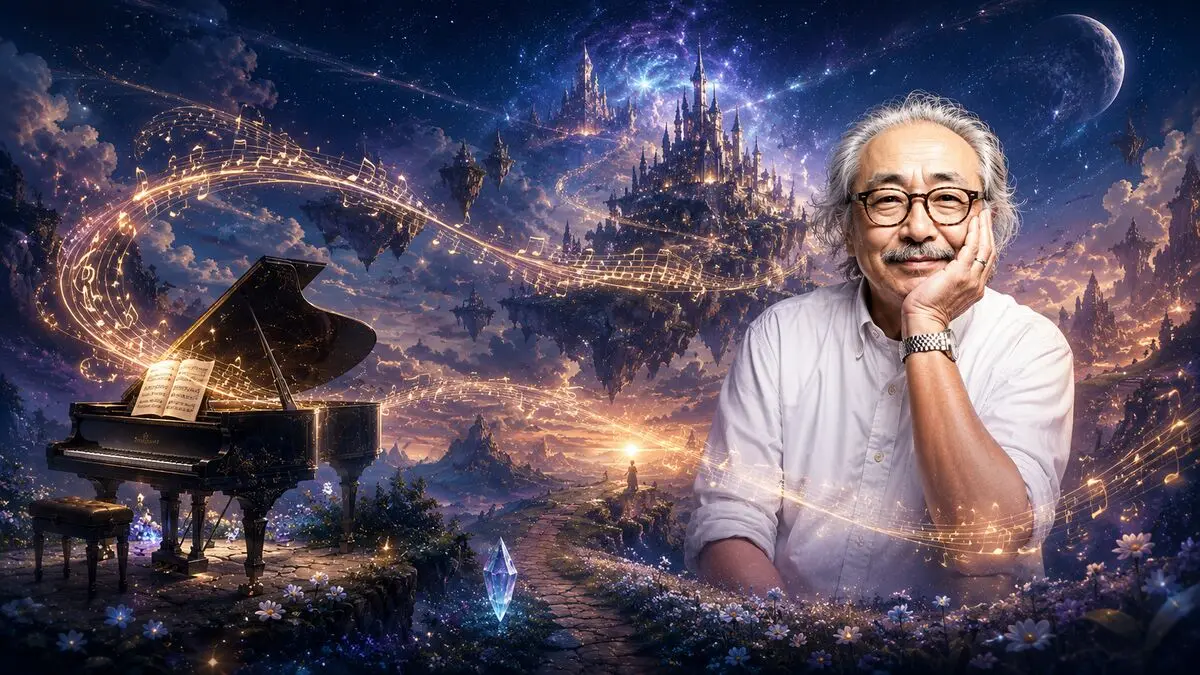
Nobuo Uematsu – Final Fantasy Music Free 24/7
Learn about the composer behind some of Final Fantasy's most iconic themes — from the Prelude to Aerith's Theme.
Who Is Nobuo Uematsu?
Even people who have never heard the name Nobuo Uematsu may have heard his music. From the Prelude that opens countless Final Fantasy adventures to "Aerith's Theme," "One-Winged Angel," "Terra's Theme," and "To Zanarkand," his compositions helped define how generations of players remember the series.
Uematsu is not only one of the composers behind Final Fantasy. For many fans, he is the musical voice of the franchise — the person who turned simple game melodies into emotional memories. This guide explains who Nobuo Uematsu is, why his music matters, and where to start if you want to explore his most important Final Fantasy works.
Why Fans Love Nobuo Uematsu
Fans often connect with Uematsu's music because it feels direct and memorable. His melodies are easy to recognize, but they carry emotional weight. A few notes can recall a character, a place, or an entire playthrough.
Strip away the orchestration and you usually find a simple, singable melody. That is what makes his music stick. It works on a cheap sound chip and it works in a concert hall. Whether played on a piano, a symphony orchestra, or a single flute, the core of the music remains the same.
Many fans admire the fact that some of the series' most memorable themes were created under severe technical limitations, proving that great melodies often matter more than technology.
From Square to Final Fantasy
Uematsu joined Square in the mid-1980s through a mix of chance and necessity. He was not hired as a composer. He was a part-time worker in a music shop who happened to write music. When Hironobu Sakaguchi needed sound for a small fantasy RPG project, he turned to the closest person who could do the job.
The result was the first Final Fantasy soundtrack, created with the most basic hardware. Uematsu had three melody channels and very little else. Instead of fighting those limits with complexity, he leaned into simplicity: short, memorable themes that could repeat, evolve, and return when the story needed them.
That first game was expected to be Sakaguchi's last, but it sold well. Uematsu stayed to compose the next one. And the next. Over the next twelve years, he shaped the music for the first nine numbered Final Fantasy games and defined much of what fans still associate with the series' sound.
If You're New to Nobuo Uematsu
Not sure where to start? These tracks offer a clear introduction to Uematsu's range and the musical identity he built for Final Fantasy.
- Prelude — The recurring arpeggio that opens many Final Fantasy games. Simple, distinctive, and deeply associated with the start of an adventure.
- Terra's Theme — A character melody from Final Fantasy VI that balances hope and melancholy in just a few bars.
- Aerith's Theme — A gentle melody from Final Fantasy VII associated with memory, innocence, and one of the series' most emotional moments.
- One-Winged Angel — The choral and orchestral final boss theme from Final Fantasy VII. Dramatic, expansive, and instantly recognizable.
- To Zanarkand — A piano-led theme from Final Fantasy X that has become one of the most performed pieces associated with the series.
Each of these tracks demonstrates a different side of Uematsu's approach: simplicity, narrative weight, melody first.
Essential Nobuo Uematsu Tracks
Here is a closer look at some of the most important tracks in Uematsu's Final Fantasy catalog.
Prelude — A short arpeggio that became one of the most recognizable signatures in gaming. It appears at the start of nearly every Final Fantasy title and instantly signals the beginning of a journey.
Main Theme / Prologue — The triumphant fanfare that opens most Final Fantasy games. It has been reorchestrated, rearranged, and performed in concert halls, but the melody has remained essentially unchanged since the NES era.
Terra's Theme — From Final Fantasy VI. A melody that carries both forward motion and quiet sadness, matching the story of a character caught between forces far larger than herself.
Celes's Theme — Also from Final Fantasy VI. A softer piece that reveals itself gradually, reflecting a character who begins as an enemy soldier and slowly reclaims her own identity.
Aerith's Theme — From Final Fantasy VII. Built around harp arpeggios and gentle strings, the melody carries a sense of innocence that makes its placement in the story even more powerful.
One-Winged Angel — The final boss theme from Final Fantasy VII, combining choral vocals with orchestral and rock layers. It remains one of the most requested pieces at video game concerts worldwide.
To Zanarkand — From Final Fantasy X. A piano-led melody that captures longing without becoming sentimental. It has been performed in classical settings far beyond gaming.
Eyes on Me — From Final Fantasy VIII. A pop ballad performed by Faye Wong that became one of the first video game vocal tracks to find commercial success outside the medium.
Style and Musical Identity
Uematsu's approach has been described as melody-first: find a strong theme and build everything around it. Rather than overwhelming the listener with dense production, he tends to let the melody carry the weight.
His work spans a wide range of influences. Rock, classical, folk, and progressive music all appear in his scores at different points. The Black Mages, his later rock band, exists partly because that side of his sensibility had been present from the start — just hidden under the limits of old game hardware.
Over the hardware generations, his palette expanded. The SNES era allowed more complex counterpoint and richer textures. The PlayStation era introduced real instrument samples and vocals. Through each shift, the core remained the same: a memorable melody that grounds the player in the emotional world of the game.
Beyond Final Fantasy
After completing Final Fantasy IX, Uematsu left Square Enix to work as a freelance composer. He continued to create music for games, including Blue Dragon and Lost Odyssey, and formed The Black Mages, a rock band dedicated to arranging Final Fantasy music for a different kind of stage.
The Distant Worlds concert series, launched alongside Uematsu, brought his music to symphony orchestras and audiences worldwide. For many fans, hearing "Aerith's Theme" or the "Main Theme" performed by a full orchestra is the definitive version of music they had only heard through a console speaker.
Uematsu has also returned to Final Fantasy on several occasions. He contributed select tracks to the Final Fantasy VII Remake and Rebirth projects, reconnecting the modern orchestral arrangements with the original voice of the soundtrack. His ongoing relationship with the fan community — through concerts, interviews, and occasional new compositions — has kept him present in the world he helped build.
Legacy
For many players, Nobuo Uematsu remains one of the defining figures in video game music. His work helped show that game soundtracks could be emotional, memorable, and worth listening to outside the games themselves.
The composers who followed him, from Yoko Shimomura to Masashi Hamauzu to Masayoshi Soken, all work within a tradition that Uematsu helped establish. Even when newer Final Fantasy soundtracks move in very different directions, the emphasis on strong melody and emotional storytelling remains — a pattern that traces back to the early days of the series.
Whether you are new to Final Fantasy or returning after years away, Uematsu's music is likely already part of your memory. The Prelude, the fanfare, the character themes — these are not just pieces of music. For many fans, they are the sound of the series itself.
Listen to Nobuo Uematsu on Materia FM
The best way to understand Uematsu's legacy is to hear the music itself. Materia FM features many of his most beloved Final Fantasy themes across the live radio stream and dedicated playlists.
- Live radio stream — a continuous mix from early classics to modern orchestral reinterpretations
- Final Fantasy VII playlist — Aerith's Theme, One-Winged Angel, and the rest of the iconic score
- Best Final Fantasy Soundtracks — discover which games have the most celebrated music
- The Evolution of Final Fantasy Music — follow the musical journey from the NES to modern consoles
- Final Fantasy Piano Collections — explore how Uematsu's themes were reimagined for solo piano
Whether you are revisiting familiar tracks or discovering them for the first time, the radio is always there.
Frequently Asked Questions — Nobuo Uematsu – Final Fantasy Music Free 24/7
Which Final Fantasy games did Nobuo Uematsu compose?
Nobuo Uematsu composed the main soundtracks for Final Fantasy I through IX, with later contributions to games such as Final Fantasy X, Final Fantasy XI, Final Fantasy XIV, and the Final Fantasy VII Remake project. His early work shaped much of the series' musical identity.
What is Nobuo Uematsu's most famous composition?
"One-Winged Angel" is probably his most widely recognized piece, especially because of its role in Final Fantasy VII. Many fans would also point to "Aerith's Theme," "To Zanarkand," "Terra's Theme," or the "Prelude" as equally important parts of his legacy.
Why did Nobuo Uematsu leave Square Enix?
Uematsu left Square Enix to work as a freelance composer and pursue projects outside the company, including The Black Mages, concert performances, and other game soundtracks. He has continued to be associated with Final Fantasy through selected contributions and live performances.