
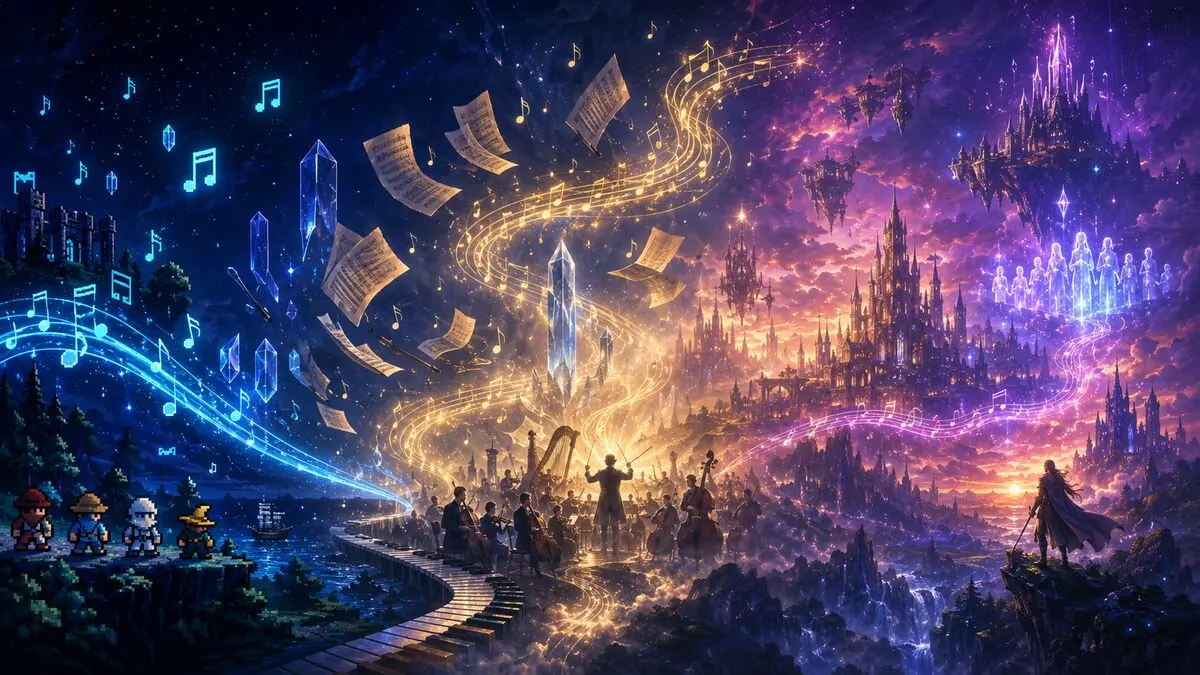
History of Final Fantasy Music – 8-Bit to Orchestral
From early 8-bit melodies to orchestral, cinematic, and vocal arrangements across generations.
The Birth of Final Fantasy Music
Few game series have evolved musically as much as Final Fantasy. What began as simple melodies on the NES eventually became orchestral concerts, vocal performances, piano collections, cinematic battle themes, and some of the most recognizable music in gaming history.
For many fans, that evolution is deeply personal. A short arpeggio from the Prelude, the first notes of a character theme, or the sound of a battle fanfare can instantly bring back memories of a world, a party, or a moment that stayed with them.
This guide follows that journey — from 8-bit beginnings to modern orchestral and online worlds — and shows how Final Fantasy music became one of the emotional foundations of the series.
When Nobuo Uematsu joined Square in 1986, he was not hired as a composer. He was a part-time worker at a music rental shop who happened to write music on the side. Hironobu Sakaguchi needed music for a struggling RPG project, and Uematsu was the closest person available. That partnership shaped the sound of Final Fantasy for over a decade.
With the NES offering only three basic channels for melody, Uematsu had to think in terms of memorable motifs rather than rich textures. He created the "Prelude" — a single arpeggio that would open nearly every Final Fantasy game for decades. The "Main Theme," sometimes called the "Prologue," established a triumphant fanfare that players would come to associate with the start of every adventure.
While other NES games often reused the same handful of tracks, the original Final Fantasy offered distinct music for towns, dungeons, and battles. That attention to melody over repetition set the tone for what would follow.
The Rise of Character Themes
The SNES expanded what game music could do, and Final Fantasy was among the first series to take advantage. With more channels and some sample capabilities, soundtracks could now feel fuller and more varied.
Final Fantasy IV marked a turning point: each main character received their own musical identity. Cecil, Kain, Rosa, and the rest had themes that appeared throughout the story — often interacting with each other as relationships shifted. This was not just background music. It was musical storytelling.
Final Fantasy V expanded that sense of adventure with a broader, more global-sounding score. But for many players, Final Fantasy VI showed how ambitious video game music could become. With 77 tracks in a single game, it featured an in-game opera, a multi-part final boss theme, and an ensemble cast where nearly every character had a distinct musical voice. It felt less like a soundtrack and more like a composition built around a story.
A Quick Timeline of Final Fantasy Music
Here is a quick look at how the music has changed across the decades, from early hardware limitations to modern orchestral arrangements.
- 1987 — Final Fantasy begins with the Prelude and a triumphant main theme on the NES.
- 1991 — Final Fantasy IV introduces character-specific themes, deepening the emotional connection between music and story.
- 1994 — Final Fantasy VI brings opera-inspired sequences and one of the series' most ambitious scores.
- 1997 — Final Fantasy VII reaches a wider audience, blending industrial soundscapes with deeply emotional orchestration.
- 2001 — Final Fantasy X blends piano ballads, vocal pieces, and cinematic storytelling into one of the series' most emotional soundtracks.
- 2013 — Final Fantasy XIV: A Realm Reborn begins a new era of music that grows continuously with each expansion.
- 2023 — Final Fantasy XVI brings a darker orchestral approach to a standalone mainline entry.
The Move Toward Cinematic Music
The shift from synthesizer chips to CD-quality audio changed Final Fantasy music more than any hardware leap before or since. Composers could now use real instrument samples, giving scores a depth that earlier hardware simply could not reproduce.
Final Fantasy VII brought the series to a much wider audience. Its soundtrack blended industrial sounds for Midgar's oppressive cityscape with intimate acoustic work for the quieter moments. "One-Winged Angel" introduced a Latin choral arrangement for a final boss theme. "Aerith's Theme" used harp and strings to create a feeling of fragility and memory that still resonates with fans decades later.
Final Fantasy VIII pushed further with "Eyes on Me," a pop ballad performed by Faye Wong that became one of the first video game vocal tracks to find mainstream commercial success. Final Fantasy IX returned to Uematsu's roots with a medieval-fantasy palette, weaving callbacks to earlier games into new compositions.
Final Fantasy X was the first mainline entry not composed entirely by Uematsu. The trio of Junya Nakano, Masashi Hamauzu, and Uematsu created a deeply emotional soundtrack anchored by "To Zanarkand," a piano piece that has since been performed far beyond gaming circles.
New Composers, New Directions
After the PlayStation era, Uematsu stepped back from full-time work at Square Enix. Final Fantasy needed new voices, and it found them.
Hitoshi Sakimoto, known for Vagrant Story and Tactics Ogre, scored Final Fantasy XII with a classical orchestral approach. The score used live recordings and a Baroque influence that gave the game a distinctive weight.
Masashi Hamauzu took the lead for Final Fantasy XIII, bringing an impressionistic and jazz-influenced style that gave the trilogy a sound unlike anything before it in the series. "Blinded By Light" became a defining battle theme that polarized some listeners but earned a devoted following.
Yoko Shimomura, already known for Kingdom Hearts, composed Final Fantasy XV. Her work mixed Latin choral music, sweeping orchestral lines, and electronic textures to match a story that begins as a road trip and turns into an epic journey.
Online Worlds and Modern Orchestration
Final Fantasy XIV presents a unique case in the series: its soundtrack grows alongside the game. Masayoshi Soken has composed extensively for the title since the 2013 A Realm Reborn relaunch, with the score now spanning hundreds of tracks across multiple expansions.
The music adapts to what players are doing: raid battle themes shift as encounters progress, and exploration themes change subtly as players move through zones. The Shadowbringers expansion in particular drew strong attention from fans and critics for its emotional weight and musical ambition.
Final Fantasy XVI brought Soken back to a single-player mainline entry. With a darker story and a focus on mythic-scale battles, the score shifts between aggressive orchestral arrangements and a more restrained, character-driven tone.
From Game Soundtracks to Concert Halls
Final Fantasy music long ago left the confines of gaming hardware. The Distant Worlds concert series, led by Arnie Roth and featuring Uematsu's compositions, has traveled across dozens of countries with full symphony orchestras and choirs. The Piano Collections series turned game themes into classical piano repertoire, introducing generations of pianists to music they might never have encountered otherwise.
The Final Fantasy VII Remake and Rebirth soundtracks have also been performed in concert halls worldwide, showing how remastered and reimagined game music can fill large venues with longtime fans and newcomers alike.
What began with a handful of memorable melodies on limited hardware has grown into a musical legacy celebrated by fans around the world. For many listeners, Final Fantasy music is inseparable from the memories they carry from each game.
2026: Resonance and HD-2D
The story keeps moving. On June 10, 2026, Square Enix announced Final Fantasy Resonance, the first Final Fantasy built in HD-2D — a style that pushes the series' pixel-art heritage forward with modern depth and lighting. The game releases on October 22, 2026.
Its music continues the pattern this timeline has followed for decades: each new technical era brings a new sound. The official soundtrack gathers 120 tracks on four CDs, with 33 new compositions by Elements Garden placed alongside music from Final Fantasy Brave Exvius, whose universe the game inherits.
Where Resonance will sit in the series' musical history is still to be written — the album arrives in Japan on October 28, 2026. To follow its release as it happens, read our Final Fantasy Resonance soundtrack guide.
Hear the Evolution on Materia FM
The best way to understand the evolution of Final Fantasy music is to hear it. Materia FM brings together live radio and curated playlists so you can move from early melodies to modern orchestral themes without managing your own queue.
- Live radio stream — a continuous mix across every era, from the NES Prelude to the orchestral ambition of FFXVI
- Browse all playlists — explore by game, mood, or specific soundtrack
- Best Final Fantasy Soundtracks — a fan-focused guide to some of the most beloved scores
Whether you want to revisit the tracks that shaped your first playthrough or discover music from games you have not yet explored, the radio and playlists are always there.
Frequently Asked Questions — History of Final Fantasy Music – 8-Bit to Orchestral
How has Final Fantasy music changed over time?
Final Fantasy music has grown from short chiptune melodies into orchestral, vocal, piano, electronic, and cinematic scores. Each generation brought new tools and composers, but the heart of the music remained the same: memorable themes built around characters, worlds, and emotional moments.
Why is Nobuo Uematsu important to Final Fantasy music?
Nobuo Uematsu shaped the musical identity of the early Final Fantasy games. His themes, character melodies, battle music, and recurring pieces like the Prelude helped give the series a recognizable emotional signature.
Who composed Final Fantasy XIV music?
Masayoshi Soken composed much of the music for Final Fantasy XIV from A Realm Reborn onward. Because the game keeps expanding, its soundtrack continues to grow through new zones, raids, trials, and story moments.