
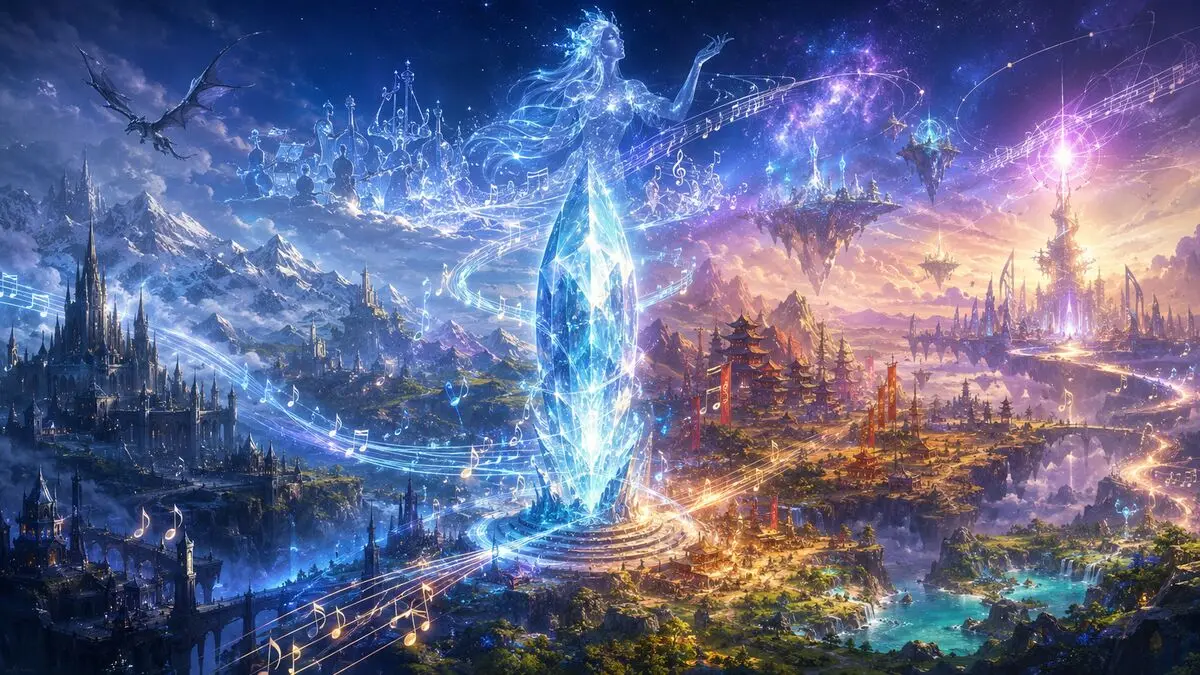
Final Fantasy XIV Music Guide (2026): Soken & Best Tracks
Explore how Masayoshi Soken's music shapes Eorzea, from quiet character moments to large-scale battles and expansion themes.
Why Final Fantasy XIV Music Is So Special
Few game soundtracks evolve as continuously as Final Fantasy XIV. Unlike a traditional RPG, FFXIV has grown for more than a decade, adding new expansions, regions, characters, and stories. Its music has grown alongside it.
From quiet moments in Gridania to large-scale raid encounters and emotional expansion finales, Masayoshi Soken's compositions have become one of the defining features of the game.
For many players, FFXIV is not only a world they remember. It is a world they can hear.
Final Fantasy XIV Music in 2026
FFXIV music in 2026 is in one of its busiest stretches in years. The game is deep into the patch cycle that followed the Dawntrail expansion, and Square Enix has lined up several official music releases around it — starting with a new soundtrack album covering the latest patches, followed by an album focused on the Arcadion, a remix album, and a new Piano Collections volume.
For a soundtrack that has grown continuously since A Realm Reborn, 2026 is a reminder that the FFXIV score is not a finished archive. It is a living catalogue that keeps producing new official releases, new arrangements, and new ways to listen outside the game.
The sections below cover what has already arrived, what is coming next, and where a new listener should start.
Trail to the Heavens — the Latest FFXIV Soundtrack
Trail to the Heavens is the newest official Final Fantasy XIV soundtrack, released on September 16, 2026. The album collects the music from patches 7.1 through 7.5 — the chapters that followed the Dawntrail expansion — with 79 tracks included on the main Blu-ray disc.
For listeners following the game's musical timeline, it fills the space between the Dawntrail original soundtrack and whatever comes next: the story moments, battle themes, and zone music that defined this stretch of FFXIV, preserved in one release.
If you have been away from the game for a while, Trail to the Heavens is also the fastest way to catch up on how the score has evolved since the expansion's launch. Released today, it is the most current entry in the FFXIV discography.
More FFXIV Music Releases Coming in 2026
Trail to the Heavens is only the first of several official FFXIV music releases scheduled for the coming weeks:
- Into the Ring: Themes from the Arcadion — September 18, 2026. An album gathering the music of the Arcadion in one release.
- Pulse: FINAL FANTASY XIV Remix Album Vol. 3 — October 14, 2026. The third volume of the remix series, reinterpreting FFXIV tracks through remixes.
- FINAL FANTASY XIV Piano Collections – Till Dawn My Tears Flow — October 14, 2026. Solo piano arrangements in the tradition of the series' Piano Collections line.
Piano fans can also explore how the broader Final Fantasy Piano Collections tradition reimagines the series' melodies — the FFXIV volume arrives just in time to join it.
If You're New to FFXIV Music
Not sure where to start? These tracks capture some of the most important moments in the game and offer a good entry point into Soken's musical world.
- Answers — The song that became the emotional foundation of A Realm Reborn. For many players, it is the first piece they strongly associate with FFXIV.
- Dragonsong — The theme that gave Heavensward its identity. It became inseparable from the story of Ishgard and its dragons.
- Revolutions — One of the most recognized themes from Stormblood, representing a shift toward a more expansive and dramatic sound.
- Shadowbringers — A darker expansion theme that immediately signaled the game was entering a new emotional territory.
- Tomorrow and Tomorrow — One of the most emotional vocal tracks in the game, often remembered for the moment it accompanies.
- Footfalls — The culminating theme of the Hydaelyn-Zodiark saga, combining vocal and orchestral elements into a dramatic finale.
Each track represents a different part of the FFXIV journey. Listening to them in order gives a sense of how the music has changed over time.
Essential Final Fantasy XIV Tracks
Here is a closer look at some of the most important pieces in the FFXIV soundtrack.
Answers — A sweeping vocal piece that set the emotional tone for A Realm Reborn. It became deeply connected to the central narrative and the emotional arc of the early game.
Dragonsong — A theme built around choir, strings, and a sense of conflict. It gave Heavensward a musical identity that fans often remember as one of the strongest in the series.
Revolutions — A dramatic Stormblood track that mixes orchestral energy with a clear emotional direction. It became one of the most recognizable expansion anthems.
Shadowbringers — A darker, more introspective expansion theme that brought a new emotional weight to the soundtrack. It stands out as one of Soken's most widely praised compositions.
Tomorrow and Tomorrow — A quiet, mournful vocal piece that accompanies one of the most emotional sections of the game. It represents a side of FFXIV music that is softer and more reflective.
Footfalls — The culmination of the main storyline, combining vocal performance with orchestral scale. It brings together themes from across the saga and gives them a sense of resolution.
The Birth of Modern FFXIV Music
When FFXIV underwent its major relaunch in 2013, the game needed not only new gameplay but a new musical identity. Square Enix turned to Masayoshi Soken, who began building a soundtrack that would grow alongside the game itself.
"Answers," the cinematic opening theme, became the emotional anchor. Its lyrics and vocal delivery connected directly to the feeling of renewal that defined the relaunch. For many players, it became impossible to separate the song from the moment they first heard it.
This foundation allowed later expansions to build on a musical language that was already established. Each new chapter added new melodies, but the core identity of the soundtrack remained consistent.
Dragonsong and the Sound of Ishgard
The Heavensward expansion took players to Ishgard, a city built around its own conflict with dragons. Soken's music responded with a heavier use of choir, cathedral organ, and a more somber tone.
"Dragonsong" became the signature of the expansion. Its connection to the city's story gave it an emotional weight that many fans still remember strongly. Other tracks like "The Worm's Head" and "Heroes" deepened that atmosphere, giving the zone music a different emotional register from what came before.
New Cultures, New Musical Influences
Stormblood expanded the world to the eastern continent, and the music expanded with it. Soken incorporated Japanese traditional instruments, including shamisen, taiko drums, and shakuhachi, alongside Western orchestral and rock elements.
The result was a more varied palette. "Revolutions" became one of the most recognized themes from the expansion, and pieces like "Wayward Daughter" added emotional depth to specific story moments. The Azim Steppe region introduced throat-singing, giving the soundtrack an even wider geographic range.
A Darker and More Emotional Sound
Shadowbringers transported players to a world that was both familiar and unfamiliar. The soundtrack leaned into a darker, more melancholy tone that matched the setting.
"Shadowbringers" and "Tomorrow and Tomorrow" became some of the most emotionally remembered tracks in the game. The expansion as a whole is often considered the moment when the FFXIV soundtrack most fully developed its own identity, separate from earlier Final Fantasy traditions while still honoring them.
For many players, Shadowbringers is the expansion where the music became inseparable from the storytelling.
The Music Keeps Expanding
Endwalker concluded the main arc of the game with a large number of new tracks, including "Endwalker – Footfalls," performed by orchestra and choir. The track's structure transitions between quiet moments and larger orchestral passages, reflecting the expansion's themes of endings and new beginnings.
Dawntrail continued this pattern by introducing new regions and new musical influences for the Tural continent. Latin-inspired rhythms, techno-industrial textures, and further orchestral work all became part of the growing FFXIV soundtrack.
Each expansion does not replace what came before. It adds another layer to a musical world that has been expanding for more than a decade.
Dynamic Music in Battle and Exploration
One of the most distinctive features of FFXIV music is how it responds to gameplay. In raid battles, boss music often shifts as the fight progresses through different phases. In exploration, zone music can change based on location, weather, or nearby landmarks.
This means the soundtrack is not a fixed experience. A player who returns to the same zone years later may hear the same theme in a slightly different form. Boss fights build tension musically as well as mechanically.
For players who spend hundreds of hours in the game, this flexibility keeps the music from becoming predictable. It is one of the reasons the soundtrack feels alive rather than static.
Why Players Connect With FFXIV Music
The longer players stay in Eorzea, the more attached they become to its music. Themes return years later with new meaning. Familiar melodies often accompany some of the game's most memorable moments.
Unlike a single-player RPG, FFXIV is a living game. Players experience expansions as they release, attend in-game events, and participate in community activities over many years. The soundtrack becomes part of that long-term relationship.
For many fans, hearing "Answers" or "Tomorrow and Tomorrow" recalls not only the scene where that track first played, but also the years of gameplay, friendships, and shared experiences that surrounded it. The music carries more than narrative meaning. It carries memory.
Why FFXIV Music Continues to Grow
Because FFXIV is an MMO, its soundtrack does not stop at launch. New expansions, patches, raids, and seasonal events add music continuously. The result is one of the largest collections of original music in any Final Fantasy game.
This constant growth is one of FFXIV's biggest strengths compared to other entries in the series. A player who returns after a year away will find new tracks waiting, and longtime players know that the next expansion will likely bring another shift in musical direction.
The soundtrack has become as much a part of the game's identity as its story, its characters, or its community.
Why Many Fans Consider Soken Uematsu's Successor
Masayoshi Soken is not Nobuo Uematsu, and his work does not need to be. But it is impossible to ignore how much the FFXIV soundtrack has contributed to the musical identity of modern Final Fantasy.
While Uematsu built the foundations with the early titles, Soken has spent more than a decade expanding that vocabulary in a format that allows for continuous growth. FFXIV contains hundreds of tracks, each connected to specific characters, regions, and emotional moments.
Rather than replacing Uematsu's legacy, Soken has developed a parallel one. Fans who grew up with Uematsu's compositions now have a second lifelong musical connection to the series, and new players encounter both traditions at once. In 2026, that catalogue keeps growing: new official albums such as Trail to the Heavens collect the music of the latest patches and give the score a life outside the game.
Where to Start with FFXIV Music
With hundreds of tracks and more than a decade of expansions, FFXIV music rewards a short starting list more than a full discography. These five themes cover the emotional core of the game's story, in story order:
- Answers — the foundation of A Realm Reborn and the first piece most fans associate with the game
- Dragonsong — the identity of Heavensward and Ishgard
- Shadowbringers — the darker turn that defined its expansion
- Tomorrow and Tomorrow — the quiet, mournful vocal side of the score
- Footfalls — the finale of the Hydaelyn-Zodiark saga
For albums, the expansion soundtracks in story order are the natural path, and Trail to the Heavens is the newest chapter — 79 tracks from patches 7.1 through 7.5 on one Blu-ray. Start there if you want the most current side of the score, or with the five themes above if you want the story first.
Listen to FFXIV on Materia FM
Final Fantasy XIV contains one of the largest and most varied musical collections in the series. From orchestral themes and vocal tracks to battle music and quiet piano pieces, Materia FM makes it easy to explore the many sounds of Eorzea.
- Final Fantasy XIV playlist — tracks from every expansion, ready to discover
- Live radio stream — a rotating mix that includes FFXIV alongside the rest of the series
- The Evolution of Final Fantasy Music — follow how the series music has changed across generations
- Best Final Fantasy Soundtracks — discover other celebrated scores from the franchise
- Who Is Nobuo Uematsu? — learn about the composer who shaped the foundation of the series
Whether you are discovering FFXIV music for the first time or returning to familiar themes, Eorzea is always playing.
Frequently Asked Questions — Final Fantasy XIV Music Guide (2026): Soken & Best Tracks
What is the latest Final Fantasy XIV soundtrack?
Trail to the Heavens is the latest Final Fantasy XIV soundtrack, released on September 16, 2026. It collects the music from patches 7.1 through 7.5, with 79 tracks on the main Blu-ray disc. Three more albums follow in 2026: Into the Ring: Themes from the Arcadion, Pulse: FINAL FANTASY XIV Remix Album Vol. 3, and the Piano Collections volume Till Dawn My Tears Flow.
Who composed Final Fantasy XIV music?
Masayoshi Soken has been the primary composer for Final Fantasy XIV since the A Realm Reborn relaunch in 2013. He has composed music across every expansion, with contributions from other arrangers and performers. His work has become central to the identity of the game.
What are the most famous FFXIV songs?
Some of the most widely recognized tracks include "Answers," "Dragonsong," "Shadowbringers," "Tomorrow and Tomorrow," and "Footfalls." Each is associated with a specific expansion and has become deeply connected to the moments where it first appears.
Why do players love FFXIV music?
FFXIV music grows alongside the player. Over years of gameplay, themes become attached to specific locations, characters, and emotional moments. Because the game is a living MMO, the soundtrack continues to expand, giving players new music to discover alongside new memories.